Sunday, 22 December 2013

Assignment 5 Project Shooting and processing

As you can see I have done a fair bit of research into choosing an event and then researching the event itself and exploring avenues to market my work, developing a publishing plan. Next in line is the shooting and processing. I carefully considered the equipment I would need or might need, purchased an extra battery, lens hood and a wet weather cover so I covered all the eventualities with regards to the weather. I made a flash "card" to bounce light and soften it if needed and quickly read up a little information about shooting at night with a flash but this if anything has highlighted the need for more exploration of lighting techniques.

So check list was :


  • 3 camera batteries fully charged and shirt with pockets so they kept warm and didn't lose charge.
  • Memory card in camera plus spares formatted and packed in bag
  • Camera sensor clear from dust
  • Lens clean and free from dust/grease spots
  • Lens selection adequate for needs - final choice was for my  EF-S 17-55mm f/2.8 IS USM. It has a constant f/2.8 aperture throughout the zoom range and a 3-stop Image Stabilizer, making ideal for a good performance and framing flexibility in low light conditions.
  • Bounce Card
  • Wet weather cover
  • Lens Hood
  • Tripod/Monopod if needed
  • memorise shot list - take it with me as a reminder

I have a set workflow and it was my intention to follow the same procedures that I always have :

  • shoot event
  • upload using Adobe Bridge and custom template
  • name images with event name and date use auto numbering from 1
  • archive onto external drive working copies on hard drive final selects to be written to disc
  • use Adobe Bridge star rating system for first and second selects
  • process selects - double check select choices
  • caption images - complete metadata
  • prepare marketable package - upload to website for download or burn hi-res to disc for mailing
  • prepare lo-res for display

Everything researched, equipment primed I was ready to go....

Tuesday, 17 December 2013

Assignment 5 Project: Marketing your work ....... Exercise: Develop a publishing plan

This for me felt quite alien. I don't sell my images, I don't promote my images and this was never the reason behind undertaking a photography course. What I wanted and still want to do, is improve my photography, understand a little more about the history, how to analyse certain areas and all the other practical, theoretical and educational aspects of working towards a degree. Making this a career move or attempting to make money out of it has never been a goal. That may alter but until now I had never considered how to market work or how to price it. Research into current prices and charges can be found here on a previous post.

Exercise: Develop a publishing plan.

First of all I had to identify my market, I considered the following:

  • tourist information websites
  • tourist information leaflets
  • individual group websites
  • Local newspapers
  • Medway Council


Areas if potential clients identified I undertook research to make sure they would possibly be interested in my work.

http://events.kentonline.co.uk/events does carry images of places to visit/upcoming events they would possibly not actually require images until next year but a potential lead to enquire how they obtain images and what they pay.


http://www.rochesterdickensfestival.org.uk/ appear to have their own photographer and get sent links to flickr sets so unlikely to want to pay for images

Other groups, I may come into contact with on the day.

Local newspapers tend to have their own in-house/freelance photographers.

http://www.medway.gov.uk/leisureandculture/events.aspx produce webpages and brochures to promote the event so another potential lead. Looking into this lead further I discovered the correct department to speak to was the Marketing/Communications team.

http://www.medway.gov.uk/councilanddemocracy/communications.aspx

On ringing the number on the website I spoke to a very helpful person who provided me with some basic information. The council does hire photographers for their publications and depending on the type of work they want carried out will influence the price they pay. Starting rates tend to begin at £75 for half a day for maybe a few shots for the local newspaper to up to £500 for half a day for more specific posed/artistic/creative shots although they confided that this sum of money hadn't been paid out for a long time and historically once, maybe twice, a year.

The council likes the highest resolution images possible but when I asked what this would be I didn't get a specific reply but was advised I could send the highest res I had on a disc or if I had an online gallery they could download from this would also be acceptable and if they wanted a higher res image they would contact me to send. I explained my situation, being a student and this being part of my coursework and that I had never sold my work before. Despite this the gentleman was still interested for me to send him copies of my work and gave me his contact details saying that they did occasionally use "ad hoc" images and would credit the originator in these instances. This was interesting to discover and the fact that he was so helpful and open to viewing my photographs has given me more confidence to possibly approach other potential clients should I cover an event again.

This has opened up my internal debate as to whether or note I should have a basic website set up to showcase some of my imagery as my flickr has "everything" on there so does not present a coherent picture of the type of photographer I want to be, or want to present to potential clients. Something to consider.

I created this web gallery as part of DPP so it may get updated to fit my purpose

http://jfocaphotography.weebly.com/index.html

Light and Flash

Knowing I was going to be shooting an all day event that would also run into the evening and possibly poor light during the day, due to the time of year, I was concerned about the lighting. I knew I could increase my ISO and also have a wide aperture but I am not a huge fan of grainy soft images. However neither am I a huge fan of using flash. Partly I don't like some of the harsh and unrealistic effects it can give but mainly due to the fact I am quite unsure of how to use one. I do own one, have done for a while but have to admit it lives in my cupboard and gets very little use if any.

I decided I needed to investigate a little more and get over my fears. I did some research looking at various websites and decided I would experiment it bouncing flash, not sure how successful it would be as I was shooting outside with the probability of not having much to bounce off of or if a bounce card would actually work outside.

http://photography.tutsplus.com/articles/an-introduction-to-indoor-and-studio-flash-photography--photo-4229

http://photography.tutsplus.com/articles/an-introduction-to-outdoor-flash-photography--photo-4272

http://www.youtube.com/watch?v=5byuHJ9uBns

http://pixsylated.com/blog/

all of these were interesting and informative in one way or another but I haven't really had chance to look and learn a lot....what I need to do is experiment and play and see what happens. To this effect I have purchased a polystyrene head and some basic craft materials to make something to bounce my flash. I also dusted off my instruction booklet to remind myself of the basic functions, it does help if you know how to turn it on and also do exposure compensation. Once I have taken shots inside and out I shall upload my results to my blog.

black and white foam plastic mesh, velcro dots

all of the above plus bounce template

foam marked out

white foam backed with black, mesh between to improve rigidity, velcro dots applied

as above side view
As per the recommendation I purchased a Neil van Niekerk book On-Camera Flash - techniques for Digital Wedding and Portrait Photography. On first glance (reading the foreword) it seems to be written simply and promises to, with practice and study. teach me how to use flash properly. I hope so as I am quite phobic. David A Williams' (who wrote the foreword) assertion that people say I don't use flash because it's so unnatural translates as "I don't know how to use flash" is partially true, I do prefer natural light but that is probably because when I use flash it does look unnatural and that is probably down to the fact that I don't know how it works and don't use it often enough to get the confidence to use it.

I recognize that images are made or broken due to the available light and how you can play with it creatively but recognizing it and being able to utilize it are completely different. I want to learn how to manipulate the flash to improve set scenarios by enhancing the existing light so fingers crossed that by the time I wade through to the end and try out some of the techniques I will have an idea of how to achieve this even if it not perfected.

Looking at the opening plates that were taken using available light it was good to see the settings with wide apertures and high ISO, this is where my older camera lets me down slightly as grain starts to become more obvious at these higher settings.

The essential concepts are:
The larger the light source, the softer the light - bouncing the flash off walls, ceilings or reflectors creates a softer light and can also make it directional.
Consider, Direction,Intensity and Colour Balance, Post production, White-Balance settings and Manual Flash vs TTL/Auto Flash.

It was really reassuring to read that taking photographs often happens in less-than-perfectly-controlled situations and that "there is simply no photographer good enough to be able to set the exact exposure, white balance, contrast and saturation" for every shot. I frequently worry that I am not getting it right "in camera" and that I need to adjust in post-production, but seems I am not alone :o)

When bouncing light off surfaces colour cast will be introduced, Niekerk suggests using the closest white balance setting then touching up as part of the usual workflow in RAW, and using the same setting throughout the shoot for ease of group adjustment rather than individual.

Manual V TTL is where my head first starts to explode so notes will need to be made and thumped into my brain! With manual the ISO and aperture settings WILL affect the exposure, with TTL it will not- proviso being as long as this is within the equipment's capabilities. I need to brush up on exposure metering, TTL flash and manual flash! I see a steep learning curve ahead......

PwDP Assignment 5 Exercise: A written plan

From planning the event to shooting...


  • Identify Event - Rochester 2013 Dickensian Christmas Festival - build up and Festival Weekend
  • Research  Event - online galleries, websites and publications
  • Permissions and access - speak to organisers discover what is happening when will permissions for buildings/characters be required
  • Site reconnaissance - visit beforehand to check out parking, lighting, vantage points, traffic closures size of area to be covered event stages and venues.
  • Provisional shot list:
Key Moments- the parades, Seven Poor Travellers' Procession, candle lit parade, street entertainment, stage performances, Punch and Judy, Carols for Christmas.

Preparations - stallholders setting up, band practice, characters getting ready/sorting costumes

Behind the Scenes - unpacking cars, relaxing with a cup of tea, Victorian Characters on mobile phones or other quirky moments

Wide establishing shots - crowds, the parades, market stalls, entertainers and the crowds, fake snow

Telephoto- Shots from a higher vantage point showing a mass of people, the parade, close up of certain characters

Close up detail - Christmas Market- chance for close up shots of merchandise, uniforms and costumes, possibly chance to capture finer details

Spectator reaction shots - children watching Punch and Judy, reaction to characters and street entertainment, fake snow 

  • Equipment check list
Be prepared to deviate from the plan and go with the flow but with these ideas in mind I should have a decent variety of images once the event has ended.

  • arrive early to ensure parking, have all equipment needed
  • park close enough that should equipment not be required it can be left in the car and not carried about all day
  • be prepared for inclement weather - waterproof cover for camera and small umbrella
  • be prepared for poor lighting, have flash gun and bounce card
  • walk the route of the parade and check all stage areas
  • permissions checked there should be no problems with access or shooting required images
  • check where the loos are and suitable place to find food and drink between events
  • have provisional shot list
  • have pen and paper to jot down names of characters/groups or anyone who wants my details or to give me theirs


PWDP Assignment Five - Project Planning Coverage of an An Event

For this assignment I sweated blood. Racking my brains as to what I could photograph in the first place, would it be possible, would it be interesting, would anyone want the images in a commercial capacity? I looked in local newspapers, tourist information places and also online at "what's on" sites.

http://www.kentonline.co.uk/kentonline/whats_on.aspx
http://www.visitkent.co.uk/whats-on
http://www.whatsoninkentlocal.com/all/search/
http://www.tripadvisor.co.uk/Attractions-g186310-Activities-Kent_England.html
http://www.visitmedway.org/events/dickensian-christmas

these gave me a flavour of what was on when and where and were also brilliant for seeing the sort of photographs used to advertise up and coming events and the type of stock images used.

As seen in previous posts I did undertake a few practice runs, some more successful than others but all good learning curves which pointed out failings, or better ways of working or just re-acquainted me with my camera.

I finally decided to cover the festive build up in Rochester Kent. It is an area fairly local to me, familiar enough that I felt comfortable in knowing the area slightly but not overly familiar that I would be complacent with what I was shooting. It has a rich history and is heavily associated with Dickens and their Christmas festivities culminate in the Dickens Christmas Festival early in December.

http://www.historyextra.com/visit/historic-rochester

Within Rochester you'll find a wonderful blend of ancient and modern in the heart of the "garden of England". It is a city steeped in history, dominated by a fine Norman Castle and Cathedral, bounded by the maritime traditions and spirit of past British naval dominance on the River Medway. It has many festivals throughout the year for example the Dickens Summer and Christmas festivals and the Sweeps festival. The whole area is linked to Dickens with the landscape and many buildings taken as inspiration for settings in his books.

http://www.dailymail.co.uk/travel/holidaytypeshub/article-615221/Great-Expectations-Dickens-Kent.html
http://www.thevoid.plus.com/bozrochester.htm
http://www.theguardian.com/books/audio/2011/oct/31/charles-dickens-audio-tours-rochester-walk

Another brilliant place to look at what was coming up was the Rochester Dickens Festival website.

http://www.rochesterdickensfestival.org.uk/ and later on Medway council provide a link to a downloadable PDF of the program of events which also gave me a wonderful idea of what to expect and images they published.

http://www.medway.gov.uk/leisureandculture/events/dickensianchristmas.aspx

http://www.kentonline.co.uk/kentonline/whats_on/2011/november/28/dickens_christmas_market.aspx

Youtube was a handy place to look...


...for the parade itself and other activities that occur over the weekend.

Having completed all this research I decided this was a suitable event, physically accessible being fairly local to me and possible to complete within the given time frame. There would be a lot of events/ entertainment occurring but being over several weekends of build up and the actual festival being held over 2 days I anticipated being able to capture most of the activities/atmosphere.

I spoke to several of the organisers involved in the run up to the Dickensian Festival and all were quite happy for me to capture their event, I was given email addresses and contact details for a few of them plus future events planned for next year.

Rochester High Street and Castle Grounds are places previously visited but to make sure I knew exactly what I was up against I took the opportunity to check out parking and lighting conditions at various points during the day.

From looking at the online galleries and the Dickensian Festival Brochure I made a provisional shot list and drew up a written plan. All that was left to do (all she laughs) was consider a publishing plan, marketing my work and think about shooting and processing and finally shot the event!


Friday, 22 November 2013

Only in England Martin Parr and Tony Ray-Jones Science Museum 2013

Only in England: Photographs by Tony Ray-Jones and Martin Parr
21 September 2013 - 16 March 2014

Fascinated by the eccentricities of English social customs, Tony Ray-Jones spent the latter half of the 1960s travelling across England, photographing what he saw as a disappearing way of life. Humorous yet melancholy, these works had a profound influence on photographer Martin Parr, who has now made a new selection including over 50 previously unseen works from the National Media Museum's Ray-Jones archive. Shown alongside The Non-Conformists, Parr's rarely seen work from the 1970s, this selection forms a major new exhibition which demonstrates the close relationships between the work of these two important photographers.

http://www.sciencemuseum.org.uk/visitmuseum/Plan_your_visit/exhibitions/only_in_england.aspx

http://www.sciencemuseum.org.uk/visitmuseum/plan_your_visit/events/media_space_events/martin_parr_in_conversation.aspx

Tuesday 19 November 2013, 19.45–21.15
IMAX Theatre

Martin Parr reflects on the profound influence Tony Ray-Jones’s practice has had on his work and their shared interest in documenting English social ritual and behaviour, with Kate Fox, social anthropologist and author of Watching the English, and Sean O’Hagan, writer on art, culture and photography for the Guardian and Observer.

Just recently I went along to the Only in England exhibition and this week attended the Martin Parr talk about the same. I decided in advance to combine both experiences within the same blog post.

Firstly the gallery space; it seems to be the "in thing" for London Museums to have photographic exhibitions, first the Natural History Museum and now the Science Museum, with its new Media Space. I guess this shows the growth in the popularity of photography and how financially lucrative it must be for these venues to run them. Although it seemed a bit weird to be jaunting off to the Science Museum the gallery was rather impressive. Apparently the 525 square metres of space make it "one of the biggest venues for photography in Britain" with the huge space cleverly divided by wooden framed walls running down the centre; a bit maze like but it does make for more wall space and was beautifully illuminated.

Photography: Kate Elliott

The exhibition itself is split into three distinctive areas, the first comprised of 60 prints from the archive of Tony Ray-Jones, secondly the early black-and-white work of Martin Parr, and lastly previously 56 unseen pictures from the archive of Ray-Jones, selected by Parr from contact sheets and negatives. It was brilliant to see these contact sheets on display and from them have an insight as to how he worked; snapping a subject then moving around to improve the composition, or waiting for the scene to develop waiting for more people to fill a space.  Apparently Ray-Jones’s preferred technique was to carry two cameras- Leica rangefinders, one @ 35mm lens and the other @ 50mm. One he would hold at eye level, pointing it at something in the distance, this meant that the chosen subject would either ignore him completely or turn to look at what he was pretending to photograph. The other he would hold at waist level, that would actually take the photo.

Parr commented on the spatial look and feel of his images, how different subjects would be looking in different directions;no-one really over lapped, this became more apparent as he went through the archive of negatives. It seems really masterful that such spontaneity resulted in the amazing compositions he captured; pictures that look busy, alive with activity and motion, and full of smaller details. I especially noted the way he grouped people together who are clearly unaware of each another at the moment the shutter clicked.Still, moving, blank-faced, excited, young, old, the whole gamut in one image. This is something I will look out for when shooting my event for assignment 5. Although not sure how successful I'll be I can but try!

It was reassuring to see the odd white or black square in his contact sheets where he hadn't quite gauged the exposure! Also dotted around were notebooks, layouts, letters and lists – in vitrines and on the walls.


Another piece of ephemera that I found fascinating was a cardboard shape of a bear he had used when employing dodge and burn on an image, copies of before and after shots and notes saying where and how he would apply it.

For those of you who are new to Tony Ray-Jones a brief biography would run something like :

His father died when he was only eight months old and after his father's death, Tony's mother took the family to Tonbridge in Kent, then and finally Hampstead in London. He was educated at Christ's Hospital (Horsham), which apparently he hated. Ray-Jones studied at the London School of Printing, where he concentrated on graphic design then in the early 1960s he obtained a scholarship that enabled him to join Yale University School of Art. In 1963 he was given assignments for the magazines Car and Driver and Saturday Evening Post.

Ray-Jones went to the Design Lab held by the art director Alexey Brodovitch in the Manhattan studio of Richard Avedon. There he got to know a number of New York "street photographers", in particular Joel Meyerowitz, Garry Winogrand, and Lee Friedlander who all influenced his later work. Snippet from the talk was that Joel Meyerowitz would often complain about his personal hygiene and make him shower when they worked in his studio!

Ray-Jones graduated from Yale in 1964 and photographed the United States until his return to Britain in late 1965.On his arrival the idea of a survey of the English at leisure gradually took shape, he wanted to document the way of life of the English "before it became too Americanised". His photographs of festivals and leisure activities are full of a surreal humour, influenced by photographers such as Henri Cartier-Bresson, Garry Winogrand, Homer Sykes and Sir Benjamin Stone. Part of this work was published posthumously in his book A Day Off (1974). There is a short video within the exhibition where Parr explains how some of the captions are wrong and they now know that certain places were not where they originally thought!

Described as eccentric and abrasive he once said to Peter Turner, the editor of Creative Camera, "Your magazine's shit".  He returned to the United States in January 1971 to work as a teacher but he disliked teaching, saying that the students were "self-centred and lazy." In late 1971, Ray-Jones suffering from exhaustion eventually sought advice, leukaemia was diagnosed, and he started chemotherapy. Medical treatment in the US was too expensive, so Ray-Jones flew to London on 10 March, was immediately admitted to the Royal Marsden Hospital where he sadly died on 13 March aged 31.

Back to the exhibition...

At a time of social change, Ray-Jones was determined to record anything that he saw as being particularly (or peculiarly) English before it disappeared forever. The street and the seaside were his main targets although he also captured the rituals of Eton boarding school and the Glyndebourne opera festival, as well as beauty contests and pop festivals. Kate Fox described both Ray-Jones and Parr as "social anthropologists with a camera" and Sean O'Hagan introduced both Ray-Jones and Parr as "capturing the spirit and mentality" of the English. Martin Parr commented while looking at TRJ's work that he was surprised by how English the English still are and how it is still possible to make work that can still be regarded as "terribly English." Ms Fox echoed this sentiment and said she can still see the English "tribe" today within the archival photographs.

It is wonderful how Ray-Jones managed to capture fine details in larger scenes, had the ability to snap the ordinary and make it interesting, the patience to stand and wait for something entertaining or quirky to occur and the skill to get close enough to a subject without them posing. His images have been described as "slices of life as seen through the lens."

Walking around the exhibition was appealing on many levels, as a slice of English history, of personal nostalgia and as a photographer seeing how he worked with and composed his images. Looking around taking notes I noticed a young man doing the same, obviously a student. I had to stop and ask him was he getting the same information/feelings from the images as me although we were from a different generation. I could remember things from my childhood in the 60's and 70's that struck chords. He said although he had no direct memories he could see things on the wall that were in his family albums at home and coming from the North the Blackpool shots and many of Martin Parr's early images were resonating.

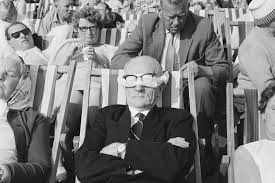
Neither TRJ nor Parr (especially latterly) shied away from capturing the quirky or seediness of our seaside towns or events. His images of the festivals and people sitting on the marquees certainly show how Health and Safety has moved on!

Tony Ray-Jones Beauty Contest Southport, 1967

Tony Ray-Jones Blackpool, 1967

Tony Ray-Jones Glyndebourne, 1967

You then moved onto the work of Martin Parr. I have never really been a fan of his so it was enlightening to see his series, The Non-Conformists, made in and around Hebden Bridge, Yorkshire in 1975, just after he graduated from art school. The title comes from the Methodist and Baptist churches that dotted the region.

Parr gave his main influences as his grandfather initially, then Lee Friedlander and Robert Frank, he was also inspired by a talk given by Bill Jay who showed the work of Tony Ray-Jones while he was still at college.

The influence of Ray-Jones is really quite apparent in this early body of work although definitely not a direct imitation, Parr had his own perception of the world and photographer's "voice". His work also looks more considered and less spontaneous. One thing I must comment on about both bodies of work is how grainy they both were...I am always surprised by this but I guess it was part of the fashion at the time and part of the ethos that serious documentary was grainy black and white! Parr mentions again the use of gaps between the people being as important as the people themselves.

It was interesting to hear Parr say that to enable this body of work to be produced he immersed himself into the lifestyle of the people and became very involved with the community but realised that this in some ways was a mistake; some of  the elders of the village mistook his professional interest as a personal interest and expected him to stay and take over certain projects.

I have to admit to not being a huge fan of Parr, due in part to his use of flash and garish colour saturation in some of his imagery. I don't know an awful lot about his work so need to look at more before I can state outright "I don't like Parr." Some of his observations are spot on and is it his fault that capturing real life makes people look weird? We aren't all air brushed, we don't all live in ivory towers or holiday in exotic climes. This is what he shows, raw England. It was very telling however, that this first body of work is missing the undertone of mocking cynicism seen within The Last Resort. Instead The Non-Conformists portrays the community with sympathy, empathy and affection even whilst capturing the surreal humour of some of the situations. I enjoyed this body of work so much that I bought the book and queued up to get it signed by the man himself.

http://www.aperture.org/shop/the-non-conformists-martin-parr-books

from the Non Conformists Martin Parr

from the Non Conformists Martin Parr

The final gallery returns to Tony Ray-Jones and the selection carefully chosen by Parr, a tricky enough job choosing your own first selects let alone deciding for someone else. Parr acknowledged that there’s no way of knowing if Ray-Jones would have ultimately approved. Here all the background information and notes really come to the fore and help us understand  the working methods and motives behind the photographer.

An exhibition I would strongly recommend.

Moving onto the talk I have lots of quick jottings, comments made by both Kate Fox and Martin Parr, chaired by Sean O'Hagan. A very entertaining evening although not possibly for all the right reasons...I went along with a former tutor and two others who were his former students. We have all kept in contact and are good friends so was a chance to catch up and giggle at certain aspects that we really should have known better about! That aside, several pertinent comments were made during the evening; once we had established that Martin Parr had previously been a train spotter and Kate Fox, as a baby, had been strapped into an Indian cradleboard and propped up around the house by her father (get the impression the conversation strayed all over the place??).

Things like:

  • We are not a classless society.
  • Parr has discovered the joy of shooting films; whilst listening to the banter between people he realised he couldn't capture that, so in some ways a photograph cannot tell the whole story.
  • He was also inspired by Tony Hancock who succinctly caught and gently mocked the pomposity of the English and this was what he tried to do with his later bodies of work.
  • He saw similarities between himself and TRJ in the respect that both had lived outside of the UK for a while and on returning saw familiar things from a different point of view.
  • As a nation we endorse the stereotype, are attracted to clichés, that although we may sometimes buck against a stereotype they are truisms, used as a starting point and given a twist.
  • The French like Parr more than we do, they like to laugh at us! Also they like photography more.
  • Due to the brashness of the modern world the only way to capture it meant it had to be in colour.
  • Try to use the whole frame for the story, not just the main subject in the middle.
  • Documentary photographers actually are no good at capturing the everyday as they want nostalgia and the quirky. Something Parr admits to doing himself in the past.
He was quite disparaging about photography students relying on clichés and that he had a list of these on his blog, again admitting to using some of these himself and actually responding to imgery containing them. However he warns against adhering too closely to what is familiar as it can be "as restricting as it can be liberating."


Then followed the typical question and answer session which I found to be a little on the predictable side with people asking stuff they could probably have found the answers to by googling them! Why, when you have the man himself in front of you ask boring questions?

My friend Natalie asked how could students be bolder and try different things when at the moment there is a problem with accessing sites due to more and more restrictions, or the general public not liking their photo taken. Did he think that the clichés he was seeing was due to the problems of access? (The irony being in a world where more n more technology exists and more and more images being taken in some ways it is harder to achieve) His response? "No-one said it would be easy. Try Harder. Get out of London." Hmmm I had to laugh, when you hold down a full time job, have a family, and your photography doesn't pay its not that simple. Hey, I guess no-one said it would be easy. When Natalie bought a copy of The Last Resort she asked for the dedication to read "You must try harder!"

Hmmmmm I wonder how hard his daughter had to work to get him to agree to this
http://www.martinparr.com/blog/page/2/ I totally acknowledge that it was her hard work that has enabled her to pursue her career nor is she a student but would the public in general have such access to Mr Parr? How many photography students would have been able to give away full sets of postcards or have Mr Parr attend their event? Am I being too cynical?

Martin Parr in conversation with Kate Fox and Sean O'Hagan. Photograph Michael Wayne Plant

Microphone in hand I asked him about the funeral selfies, I had read the story a while ago and then saw it had been picked up in a weareoca blog post. http://www.weareoca.com/photography/the-selfie/

I was interested to discover if he found them disrespectful because I didn't? Although you had to wonder at the motives behind some of the more scantily clad young ladies talking about their sadness over departed grandad, I could fully empathise with the grinning young man who reported that if she was seeing his image "gran would have been grinning away" to know he was having fun and with her sense of humour she would have loved it. My mum had been the same. She didn't want sadness or people dressing in black at her funeral, we had fun, bright colours, non conventional music and pictures uploaded to facebook prompted queries from people as to "that looks fun were you at a party" errrrm no it was my mum's funeral....


Martin Parr thought along similar lines, he thought it was more our own straightlaced moral upbringing that made us feel it was wrong to photograph at funerals (if you're wondering I have shots of her coffin and the vegetables...yes vegetables...placed in a basket on top) He had in fact had the suggestion of a body of work along those lines rapidly dismissed when he had put it forward. I find it quite strange that we have no worries when pointing a camera at dignitaries and onlookers at state funerals but baulk at the thought of doing it closer to home? I am not suggesting photobombing or intruding upon a stranger's intimate moment but that's what the press do on a regular basis so why the issue when people do it on a personal level? Maybe this is my own eccentricity revealing itself lololol.

There the evening ended with the book signing and the train journey home....

Martin Parr book signing Natalies book, photography Michael Wayne Plant.
Thanks to Michael for sending the images, cropped out Natalie as she hates her photo being taken. Typical photographer who likes to be behind the camera not in front!


Thursday, 14 November 2013

Death in the Making - Photographs of War by Robert Capa - Atlas Gallery June 2013


What can I say? I was so lucky to be invited along by a friend to see this exhibition. As I said in an earlier exhibition review it isn't often you get the chance to see first hand images created and printed by icons of photography.To mark what would have been his100th birthday London’s ATLAS Gallery curated a diverse exhibition to celebrate his life and work. Not only were numerous rare prints on show but you could also have sight of his Leica camera. Robert Capa was co-founder of Magnum Photos, of which ATLAS Gallery is the official UK gallerist. Owner Ben Burdett said: “It is indeed a rare honour to host such an exhibition. Capa’s unique mixture of energy, devil-may-care bravery, humanitarian concern and enormous charisma has always been a massive inspiration to me.”

I went to see the eyewitness - Hungarian Photography exhibition and it was super to be able to see more of his work on display here. I had forgotten he was born was born Andrei Friedmann!

In 1954 Capa answered Life’s call for a photographer for the Indochina front. Having sworn he would never report from another theatre of war he was eventually persuaded to accompany a French regiment into action. On May 25, 1954, he was killed by a land-mine while covering their advance in the Red River Delta in Vietnam. The rest is history... More information and pictures of the gallery space can be found on Atlas' Facebook page here:

https://www.facebook.com/media/set/?set=a.634669619895029.1073741824.154633444565318&type=3

Most people are aware of Capa due to the 11 frenetic, splashy and blurred  D-Day landing shots he took, those and the infamous Loyalist Militiaman at the Moment of Death, Cerro Muriano, September 5, 1936, which is accused not only of being staged but also of being taken by another photographer; Gerda Taro - companion and professional partner of Capa. Indeed these photographs are on display and if you had deep pockets you could have bought one, varying in price from as low as £1500 for one printed in 2007 through to those priced at £11000.00, for example Mothers of Naples 1943 bearing the artists credit stamp, LIFE photo stamp and annotations on verso. Others were marked P.O.A so I dreaded to think what they were asking for those. Some were signed by Cornell Capa.

There was a mix of war imagery, political rhetoric -Trotsky Speaking in Copenhagen, 1932 - and those affected by the events happening around them - Tired Little Girl Amidst Refugees, 1936. Not all show despair as the laughing Two Republican Volunteers Resting, Barcelona, 1936 will testify.

With Remembrance Day just gone and next year being the 100th anniversary of WWI it is honestly, for the majority of us, really difficult to truly appreciate the horrors of war, or to have lived at a time when Western political leaders were so terrifyingly commanding. Capa’s photographs seem to succinctly capture what happened at the time, record what both soldiers and civilians went through and have subsequently become important historical and sociological documents, every human emotion seems to have been preserved for posterity within his work.

Also part of the exhibition were a number of images by Russian war photographer Dmitri Baltermants, who was operating on the Russian front at the same time as Capa was reporting from World War II.

Having never heard of him before I did a little research. Baltermants was born in Warsaw, Poland. His father served in the Imperial Russian Army and was apparently killed in WWI. Originally a maths teacher he became a photojournalist in 1939 at some point becoming an official Kremlin photographer. During the Second World War he covered the battle of Stalingrad, and the battles of the Red Army in Russia and Ukraine when he was twice wounded. Working for the Kremlin undoubtedly meant many of his images were censored but luckily they became public much later on during the 1960's.

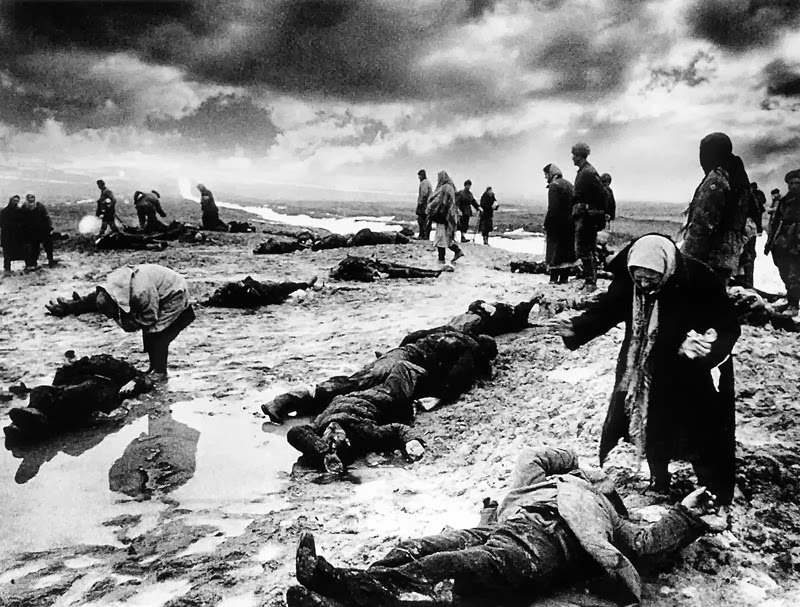
Dimitri Baltermants Grief 1942 
This is one of his more famous images, called "Grief", depicting a Nazi massacre of Jews. It shows the grief of village women as they search for the bodies of their loved ones. The sky was apparently burnt in during processing to add more drama. More info can be found on the website below but you need to hit translate!

http://baltermants.com/#/

Some of his images resemble closely those of Capa, but they would do given the subject matter, technology available and the conditions they were shooting in.

Dimitri Baltermants Attack 1941

Once more blurred, grainy and full of action, he captures the moment perfectly.

Dimitri Baltermants Crossing Oder River 1945
Dimitri Baltermants Playing Tchaikovsky 1945
Maybe it is only me that hasn't heard of him but the more I look at his work the more it draws me in, he too had a knack for telling a narrative, capturing raw emotion and energy. If it hadn't been for the Russian propaganda black out and the death of Capa maybe his name would also trip off the tongue when discussing great war photographers?